Travel is fatal to prejudice, bigotry, and narrow-mindedness, and many of our people need it sorely on these accounts. – Mark Twain, The Innocents Abroad
Mark Twain had it right. This quote definitely holds true for my experience in Medellín. Maybe not so much for dispelling prejudice or bigotry, but definitely for giving me a new perspective on Colombian society.
Colombia, frankly, has an image problem, and with good reason. The new tourism pitch being shown in the US and Europe is ¨Come to Colombia. The only risk is not wanting to leave.¨
As opposed to the old motto ¨Come to Colombia. The only risk is someone else not wanting you to ever leave.¨
He he. Sorry…forgive a guy a little backpacker humor.
In the past, whenever I heard mention of Medellín, only one word would come to mind – cocaine. Okay, cocaine, and possibly the name Pablo Escobar.
Unfortunately, Pablo Escobar, dead since 1994 when he was gunned down, is still Medellín´s most famous citizen. His story is a fascinating one, but also extremely violent. I won´t go into it, but basically he was head of the Medellín cartel for more than a decade, at a time in the 1980´s when cocaine first came to the masses.
At his height he controlled more than 70% of the cocaine trade, and was ranked by Fortune magazine as one of the top 10 richest people in the world during the 1980´s, with a fortune of over $7 billion.
But back to the topic of getting a new perspective on Colombia. Derek and I arrived by bus around 9am on Tuesday morning, and very quickly boarded the Medellín Metrorail, a very modern public metro system running through the center of the city.
We made our way to our hostel (Casa Kiwi…which was to be our glory and downfall), and then headed back out to get a glimpse of the city.
Medellín is Colombia´s second biggest city behind Bogotá. It is home to about 3.5 million people, situated at 1500 meters above sea level, in a valley between two tall mountain ranges.
It is home to universities, museums, art galleries, a botanical garden, fine hotels, colonial architecture, a metrorail system, and all kinds of other cultural ¨stuff¨ that I wouldn’t even begin to know how to appreciate.
Basically, I was really impressed! The city was trendy, modern, and clean. The kids were all dressed in the latest styles. For a moment, I felt like I had wandered back to Spain. It was easily the nicest city I have been to during my travels in Central or South America (including Panama City).
The cool weather was also extremely welcome after a week and a half of sweating it out in the steamy, low-lying region around Cartagena.
The people of Medellín are known in the country as paisas (pronounced pie-zas), a title which they are truly proud to hold. Being a paisa means you are down-to-earth, middle class, and most importantly…not from Bogotá.
I never realized it before coming to Colombia, but the two leading Colombian cities have a fierce rivalry. It can almost be compared to the relationship between Madrid and Barcelona in Spain, or Florence and Rome.
Here in Colombia, Bogotá represents power, the rich oligarchy, and white-Spanish decent. Bogotá, since colonial times, has been the seat of the government.
Medellín, one very tall mountain range away, has always somewhat resented the snobbishness and control of the capital. It is a constant source of conversation when talking with people from Medellín.
¨Medellín has the best people, tastiest food, most comfortable weather, and most beautiful women in the country¨, they will say to you. When I told my cab driver this morning that I was headed to Bogotá he said, ¨Why are you going there?! They´re all a bunch of snobs. And the women all have flat asses!¨
I was in no position to argue with him, so only complemented him on the beauty of the paisa women, and promised to continue on to Bogotá so I could find out for myself.
Derek and I didn´t get into many cultural activities during our four days in Medellín. Unless drinking can be included as a cultural activity…which I think it probably can be.
As previously mentioned, our hostel, Casa Kiwi, was to be our downfall.
The hostel is situated in the hills above the city, in a very rich, trendy neighborhood called El Poblado. The streets were lined with stylish cafes, restaurants, and bars. In addition, the hostel boasted a bar ($1 bottles/$1.50 micro-brew beers), a large 3-tiered TV room, a kitchen, pool table, extensive deck overlooking the street, and rooftop pool and patio.
It was obviously a recipe for disaster.
To be fair, the start of the World Cup also played a part in the resulting debauchery. Starting on Thursday morning, a bunch of hung-over, smelly backpackers would clamber down the stairs, filling the TV room before the 8:30am start.
This may not seem like a very impressive feat, but it is when you know a lot of the crowd didn´t go to sleep until 5am, and has been going at that pace for several days.
Irish-accented streams of curses would fill the air, insulting some French player, followed by all kinds of chatter and shouts in Spanish, Dutch, Swedish, German, and the occasional Isreali ranting in Hebrew…which is worth hearing if you ever get the chance.
Up until a couple of days ago I had underestimated the impact the World Cup was to have on my travels.
We met one American traveler, Jeff, whose sole plan for the next month was to hole up in Medellín so he could watch all of the 64 World Cup games. I have to admit, it didn´t sound like a bad plan, especially considering the $1.50 microbrews.
Ironically, none of the five countries I am traveling through qualified for the World Cup. But I don´t think it matters. Between the motley crew of backpackers and Latin American love for football, it should make for some interesting World Cup viewing.
Unfortunately, this morning I had to say goodbye to Derek, as I had to press on to the airport for a quick flight to Bogotá. Derek has to head back to Costa Rica on Sunday to continue working for Peace Corps, which leaves me traveling alone for awhile.
Now after a quick 50 minute flight, (as opposed to the 10 bus ride through the mountain) I´m installed in another trendy hostel in the Bogotá city center. I´ll be here until Wednesday, before flying on to Quito.
I´m kind of looking forward to a few days traveling alone…going at my own pace. I´d also like to get out more than we did in Medellín to understand the historic sites around Bogotá a little better.
But this hostel is also equipped with a bar area selling cheap beer, a large flat-screen TV, and a bunch of soccer loving backpackers…so we´ll see how long that plan lasts.
I keep intending to write a little background on Colombia´s violent history, which is important to understanding the country today, but I seem to have run out of steam again. (i.e. time for a beer and conversation with fellow travelers.)
Cheers.
Saturday, June 12, 2010


Monday, June 7, 2010
Cartagena and Around
My Colombia travel partner, Derek, and I met up at the airport in Panama City and boarded a plane for Cartagena on Saturday, June 29th.
Derek is still a Peace Corps volunteer in Costa Rica. He has extended for a third year as a Peace Corps Volunteer Leader, which means he is based out of the central office in San José supporting our project leader.
We arrived to Cartagena, took a taxi to our hotel, dropped of our stuff, and then started walking around to check out the city for the remaining two hours of daylight left.
We made our way to Cartagena´s old city, to the old city wall by the sea, and then started hovering towards a bar to watch the sunset. We were instantly disappointed after talking to the hostess. ¨No estamos serviendo liquor hoy¨. Or that is, there would be no sale of booze for the next two days due to the presidential elections. Talk about disappointment! :)
So we spend the next two days wandering around the city, checking out the beautiful architecture of the restored Old Quarter, but without being able to enjoy a little badly needed alcoholic beverage. And we had the perfect chance to buy a duty free bottle of whiskey in the Panama City airport, in basically a duty free country...so dumb!
After two days we got tired of Cartagena. It was, frankly, too posh and touristy. Cartagena is the major tourism hotspot for Colombia national tourism, and is also growing pretty popular with some Europeans and random travelers. The Old Quarter was filled with expensive hotels and restaurants (or at least relatively, considering our budget constraints). A full meal at a good recent would probably run you between $40-$50 a person.
We were able to find some family run places out of the Old Quarter with full sit-down meals for around $5. To Cartagena´s credit, they had done a very good job restoring the old section of the city to its original styles. It looked like a refined port city your would expect to find in Spain.
On Monday, we headed up the coast about 4 hours to a port town called Santa Marta. It was not what you would call beautiful, but it was more authentic, and there was a really cool backpacker hostal located there, so Derek and I were happy.
We stayed there two nights, taking one day trip to see a nearby fishing village turned tourist outpost, Taganga. Once again, we were not that impressed! The village was filled with Colombian and European tourists, mostly there to do scuba diving. So we retreated to Santa Marta again to regroup and formulate a new plan.
Derek wanted to find a more authentic Colombian town in the interior of the country, so after a little looking around on wiki-travel, we set our sights on a small city called Valledupar (pronounced Va-yay-du-par), located about 5 hours inland not far from the Venezualan border.
On Wednesday we set off for Valledupar. As soon as we boarded the bus/van that was taking us, we started talking to our fellow passengers, and getting a better feel for Colombians.
The gentleman sitting next to me, about 50 years old, was going to a town located just before Valledupar. He was headed there to manage some affairs of a pension that he received from his wife´s work. His wife had died two years ago from hemorragic dengue fever, and the pension had been left behind to the family. I felt bad for him, as he had three young kids at home with no mom.
We began talking about politics, as well as the situation of tourism in the area. ¨You would not have come here 8 years ago,¨ he told me. He explained to me that up until 5 years ago, paramilitaries based in the area were very powerful, and they would come out of the mountains to block the same highway we were traveling at that moment, and then ¨go fishing¨, as they called.
This meant they would basically pull everyone out of the cars and buses at gunpoint, find out who were the people of value - lawyers, politians, police men, soldiers, and some tourists - and then once they had rounded up several dozen people, they would march them off into the mountains, later asking for ransoms from the families or appropriate authorities.
My follow-up question was naturally, ¨Well do they still do that?!¨ ¨No¨, he said, ¨they have been pushed back into the mountains since several years ago.¨ So I breathed a little sigh of relief at that news.
We arrived to Valledupar, encountering some rain along the way, but without problems. And as I am writing now we have been here for 5 days!
Here in Valledupar we have found a very unique city. The city is extremely safe, with security having been restored to the region within the last few years, and has basically been untouched by tourists.
As we´ve walked around the city the last few days, doing different activities like swimming in a couple rivers, or going out to eat, the people have taken a lot of interest in us. It´s obvious that most people do not see many foreigners in the area. And once Derek and I begin talking, they are usually even more suprised. ¨Hey! The gringos speak Spanish!¨.
We have been asked several times, ¨How did you decide to come to Valledupar?¨ We usually just respond that we´ve always been interested in the country, the history, and the culture, but the security situation was never good enough to want to travel in Colombia. ¨How do you like it?¨, they then ask, to which we reply that it´s been fantastic.
During our second day in Valledupar we visited a swimming hole about 1 hour outside of the city, in a small town. There we went swimming and diving off rocks into a local river. We were there alone with just a few locals. It was a lot of fun.
After swimming, we ran into a lady in town that was friends with the hostal-owner in Valledupar, and she invited us back to her house for coffee.
While we were there conversing, a patrol of 5 soldiers came up to the house, they were friends of the lady. She gave them coffee as well, and we began to talk with them. One of the young guys was carrying a machine gun. ¨That´s looks heavy!¨, I said to him. His response kind of suprised me, ¨Here..pick it up!¨ So we posed for a few photos with the soldiers.
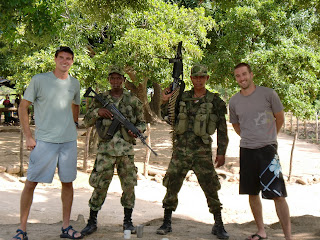
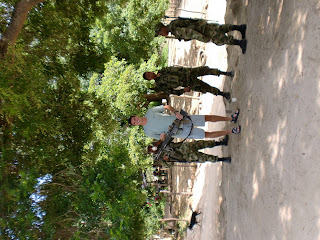
The talked with us for about 20 minutes, finished their coffee, and then continued on their way. They had been patroling in the hills since around 6am, and considering it was around 3pm, they had walked quite a ways carring some heavy guns.
The lady spoke very well of the soldiers after they had left. She explained to us that before the government had negotiated a truce with the paramilitaries (or basically, privately armed groups) they used to pass through the countryside from time to time killing people, rich or poor.
Pretty much everyone has acknowledged the security situation has improved dramatically under the eight years with Alvaro Uribe as president. It is probably for that reason that during the elections last week, the candidate from Uribe´s party, Juan Manuel Santos, received about 48% of the vote.
This was still not enough for him to win the presidency, but he will almost surely be the next president following a run-off scheduled for June 20th.
While I´m still in Colombia, I´d like to get into a little more detail about the history of Colombia, about the left-wing FARC, right-wing paramilitaries, government forces, and drug traffickers that have made this country such a dangerous, violent place in the past. This violence is something that still exists within the country, but is much smaller in scope.
For now, Derek and I have to head out the door to catch an overnight bus to Medellín, Colombia´s second biggest city. Medellín has a pretty terrible reputation, considering it was the center of the cocaine trade during the Pablo Escobar years, however I think we are going to be suprised by what we find. Everything we have found about the city by talking to people and doing research suggests it is an extremely modern, prosperous, and safe international city.
So we are going to find out. I look forward to writing about this next leg of our trip...and seeing the World Cup matches starting on Friday!
Derek is still a Peace Corps volunteer in Costa Rica. He has extended for a third year as a Peace Corps Volunteer Leader, which means he is based out of the central office in San José supporting our project leader.
We arrived to Cartagena, took a taxi to our hotel, dropped of our stuff, and then started walking around to check out the city for the remaining two hours of daylight left.
We made our way to Cartagena´s old city, to the old city wall by the sea, and then started hovering towards a bar to watch the sunset. We were instantly disappointed after talking to the hostess. ¨No estamos serviendo liquor hoy¨. Or that is, there would be no sale of booze for the next two days due to the presidential elections. Talk about disappointment! :)
So we spend the next two days wandering around the city, checking out the beautiful architecture of the restored Old Quarter, but without being able to enjoy a little badly needed alcoholic beverage. And we had the perfect chance to buy a duty free bottle of whiskey in the Panama City airport, in basically a duty free country...so dumb!
After two days we got tired of Cartagena. It was, frankly, too posh and touristy. Cartagena is the major tourism hotspot for Colombia national tourism, and is also growing pretty popular with some Europeans and random travelers. The Old Quarter was filled with expensive hotels and restaurants (or at least relatively, considering our budget constraints). A full meal at a good recent would probably run you between $40-$50 a person.
We were able to find some family run places out of the Old Quarter with full sit-down meals for around $5. To Cartagena´s credit, they had done a very good job restoring the old section of the city to its original styles. It looked like a refined port city your would expect to find in Spain.
On Monday, we headed up the coast about 4 hours to a port town called Santa Marta. It was not what you would call beautiful, but it was more authentic, and there was a really cool backpacker hostal located there, so Derek and I were happy.
We stayed there two nights, taking one day trip to see a nearby fishing village turned tourist outpost, Taganga. Once again, we were not that impressed! The village was filled with Colombian and European tourists, mostly there to do scuba diving. So we retreated to Santa Marta again to regroup and formulate a new plan.
Derek wanted to find a more authentic Colombian town in the interior of the country, so after a little looking around on wiki-travel, we set our sights on a small city called Valledupar (pronounced Va-yay-du-par), located about 5 hours inland not far from the Venezualan border.
On Wednesday we set off for Valledupar. As soon as we boarded the bus/van that was taking us, we started talking to our fellow passengers, and getting a better feel for Colombians.
The gentleman sitting next to me, about 50 years old, was going to a town located just before Valledupar. He was headed there to manage some affairs of a pension that he received from his wife´s work. His wife had died two years ago from hemorragic dengue fever, and the pension had been left behind to the family. I felt bad for him, as he had three young kids at home with no mom.
We began talking about politics, as well as the situation of tourism in the area. ¨You would not have come here 8 years ago,¨ he told me. He explained to me that up until 5 years ago, paramilitaries based in the area were very powerful, and they would come out of the mountains to block the same highway we were traveling at that moment, and then ¨go fishing¨, as they called.
This meant they would basically pull everyone out of the cars and buses at gunpoint, find out who were the people of value - lawyers, politians, police men, soldiers, and some tourists - and then once they had rounded up several dozen people, they would march them off into the mountains, later asking for ransoms from the families or appropriate authorities.
My follow-up question was naturally, ¨Well do they still do that?!¨ ¨No¨, he said, ¨they have been pushed back into the mountains since several years ago.¨ So I breathed a little sigh of relief at that news.
We arrived to Valledupar, encountering some rain along the way, but without problems. And as I am writing now we have been here for 5 days!
Here in Valledupar we have found a very unique city. The city is extremely safe, with security having been restored to the region within the last few years, and has basically been untouched by tourists.
As we´ve walked around the city the last few days, doing different activities like swimming in a couple rivers, or going out to eat, the people have taken a lot of interest in us. It´s obvious that most people do not see many foreigners in the area. And once Derek and I begin talking, they are usually even more suprised. ¨Hey! The gringos speak Spanish!¨.
We have been asked several times, ¨How did you decide to come to Valledupar?¨ We usually just respond that we´ve always been interested in the country, the history, and the culture, but the security situation was never good enough to want to travel in Colombia. ¨How do you like it?¨, they then ask, to which we reply that it´s been fantastic.
During our second day in Valledupar we visited a swimming hole about 1 hour outside of the city, in a small town. There we went swimming and diving off rocks into a local river. We were there alone with just a few locals. It was a lot of fun.
After swimming, we ran into a lady in town that was friends with the hostal-owner in Valledupar, and she invited us back to her house for coffee.
While we were there conversing, a patrol of 5 soldiers came up to the house, they were friends of the lady. She gave them coffee as well, and we began to talk with them. One of the young guys was carrying a machine gun. ¨That´s looks heavy!¨, I said to him. His response kind of suprised me, ¨Here..pick it up!¨ So we posed for a few photos with the soldiers.


The talked with us for about 20 minutes, finished their coffee, and then continued on their way. They had been patroling in the hills since around 6am, and considering it was around 3pm, they had walked quite a ways carring some heavy guns.
The lady spoke very well of the soldiers after they had left. She explained to us that before the government had negotiated a truce with the paramilitaries (or basically, privately armed groups) they used to pass through the countryside from time to time killing people, rich or poor.
Pretty much everyone has acknowledged the security situation has improved dramatically under the eight years with Alvaro Uribe as president. It is probably for that reason that during the elections last week, the candidate from Uribe´s party, Juan Manuel Santos, received about 48% of the vote.
This was still not enough for him to win the presidency, but he will almost surely be the next president following a run-off scheduled for June 20th.
While I´m still in Colombia, I´d like to get into a little more detail about the history of Colombia, about the left-wing FARC, right-wing paramilitaries, government forces, and drug traffickers that have made this country such a dangerous, violent place in the past. This violence is something that still exists within the country, but is much smaller in scope.
For now, Derek and I have to head out the door to catch an overnight bus to Medellín, Colombia´s second biggest city. Medellín has a pretty terrible reputation, considering it was the center of the cocaine trade during the Pablo Escobar years, however I think we are going to be suprised by what we find. Everything we have found about the city by talking to people and doing research suggests it is an extremely modern, prosperous, and safe international city.
So we are going to find out. I look forward to writing about this next leg of our trip...and seeing the World Cup matches starting on Friday!
Saturday, May 29, 2010
Boquete
Just returned to Panama City after having spent 3 days in the beautiful mountain town of Boquete, near the western border with Costa Rica. I wasn’t crazy about taking a bus 7 hours back towards CR, but the cool mountain air more than made up for it.
The town is situated at about 1200 meters of elevation, surrounded by mountain streams and lots of cloud forest. On Thursday we went for a hike, with my goal being to site the famed quetzal, a colorful bird native to the area (photo above, as example). But unfortunately, no quetzals were spotted.
On Friday, Mike and I went our separate ways. Or that is, he went his way and I stayed behind in Boquete. Mike has a couple more days than me in Panama, so it made sense for him to work in one last leg of the trip. So yesterday morning he took off for the islands on Panama’s northwest coast, known as Bocas del Toro.
With Mike gone in the morning, I lounged around the hostal with the staff and a few other travelers. Some of the hostal “staff” had come to Boquete with plans to stay only a few days, then ended up being recruited by the friendly and gregarious owner, Miguel. So two of the would-be backpackers ended up staying there a couple of months.
Later in the day, several of us hopped into Miguel’s truck, to drive up the mountain for a quick hike and a few afternoon beers. It was clear after the first few minutes that they intended to lure me into sticking around Boquete. “Don’t take the morning bus tomorrow. It’ll be full and makes a million stops. Go in the afternoon,” says Miguel.
They were a lot of fun, but I assured them I would be leaving in the morning.
So now I am back in Panama City at the same hostel where we started the trip, getting ready for a new leg of the adventure. At 3pm I head to the airport, to meet up with a Peace Corps friend coming from Costa Rica, and then board a flight to Cartagena, Colombia.
A few words should probably be said about my Panama travel partner, Mike, who I’m going to miss. Mike and I had not really hung out much for more than 5 or 6 years, ever since we studied abroad together in Valencia, Spain. However, when we spoke at Christmas and he mentioned he was interested in making a trip to Latin America, I jumped at the chance to travel with him.
My instincts did not fail me. He’s been a lot of fun to hang out with these days – always game for an adventure and meeting new people.
On the islands in San Blas, Mike kept myself and our fellow islanders marveled by his knowledge of all kinds of subjects – from biology and geography, to astronomy and Spanish (Mike is fluent). At some point during the trip Mike mentioned that he was interested in possibly seeking work as a teacher for his next job.
After listening to him talk very articulately about a variety of subjects for two days, it became clear that he would make an incredible teacher. So between myself and our other island friends, we encouraged him to go back home and become a teacher. The regular hours of a teaching job would also suit him, as he is coming from a job where he burned out due to the extremely demanding and unregular hours.
By Boquete, it looked like our lobbying was starting to bear fruit. Once we said our goodbyes, Mike had decided he would go home to begin the process of qualifying to become a teacher, which first involves taking a few required education courses at a university.
So I’m excited for him, and the kids that will benefit if he does go on to teach. I also look forward to seeing him later this year in Melbourne, FL, where he currently lives, to watch one of the last shuttle launches.
Colombia / Presidential Elections
Now, it’s on to Colombia. I’m extremely excited to be going to this country, where the Latin feel should be much stronger than Panama, which has had so much American influence.
We fly to Cartagena, on the Caribbean coast. Today, Cartagena is know for it’s tourism. It was recommended by a State Department friend, as it is friendly to tourists and safe.
Also, we will be fortunate to be present for Colombia’s presidential election on Sunday. The two frontrunners are the Conservative Party candidate, Juan Manuel Santos, and the Green Party candidate (not related to the American Green Party), Antanas Mockus.
The election comes at an important time for Colombia. The previous 8 years under the Conservative president, Alvaro Uribe, have brought great gains in the security situation throughout the country, as the military has greatly weakened the left-wing FARC.
Because of these changes, the conservative candidate should, and does, hold an advantage. Santos is up by roughly two points (38% to 36%) over Mockus in the latest polling.
However, it is extremely suprising that Mockus has even been able to achieve these numbers. Somehow, by campaigning with an emphasis on human rights and environmental protection, he has been able to strike a chord with Colombians, especially young voters.
It appears that after the recent security gains, Colombians are beginning to demand something more from their government.
Also, Mockus is no pushover on defense. Pretty much any presidential candidate in Colombia must have a proven defense record to be a serious contender, with the country’s history of violence. Mockus is a former mayor of Bogota, credited with reforming the local government, and ex-university professor in Mathematics and Philosophy.
Santos, on the other hand, is the establishment candidate. He is known as Uribe’s hand-picked sucessor, as he was Defense Minister under Uribe.
Colombia appears to be on the cusp of some very important changes in its society. I’m really excited to see what this presidential election will bring. Also, I’m interested in being around the atmosphere of the election, and seeing if it is at all similar to the Costa Rican attitude towards elections.
Costa Ricans mainly treat the elections as they would a football game, taking to the streets with flags of their party (or team), driving down the streets honking, and yelling for their candidate. I imagine it might be something similar in Colombia. It will also be an opportunity to talk politics with some Colombians.
The election winner must receive at least 50% of the vote to win, which would be extremely difficult for Mockus or Santos to achieve, so we can most likely expect a runoff.
Will come back in a few days with some thoughts on Cartagena and the election.
The town is situated at about 1200 meters of elevation, surrounded by mountain streams and lots of cloud forest. On Thursday we went for a hike, with my goal being to site the famed quetzal, a colorful bird native to the area (photo above, as example). But unfortunately, no quetzals were spotted.
On Friday, Mike and I went our separate ways. Or that is, he went his way and I stayed behind in Boquete. Mike has a couple more days than me in Panama, so it made sense for him to work in one last leg of the trip. So yesterday morning he took off for the islands on Panama’s northwest coast, known as Bocas del Toro.
With Mike gone in the morning, I lounged around the hostal with the staff and a few other travelers. Some of the hostal “staff” had come to Boquete with plans to stay only a few days, then ended up being recruited by the friendly and gregarious owner, Miguel. So two of the would-be backpackers ended up staying there a couple of months.
Later in the day, several of us hopped into Miguel’s truck, to drive up the mountain for a quick hike and a few afternoon beers. It was clear after the first few minutes that they intended to lure me into sticking around Boquete. “Don’t take the morning bus tomorrow. It’ll be full and makes a million stops. Go in the afternoon,” says Miguel.
They were a lot of fun, but I assured them I would be leaving in the morning.
So now I am back in Panama City at the same hostel where we started the trip, getting ready for a new leg of the adventure. At 3pm I head to the airport, to meet up with a Peace Corps friend coming from Costa Rica, and then board a flight to Cartagena, Colombia.
A few words should probably be said about my Panama travel partner, Mike, who I’m going to miss. Mike and I had not really hung out much for more than 5 or 6 years, ever since we studied abroad together in Valencia, Spain. However, when we spoke at Christmas and he mentioned he was interested in making a trip to Latin America, I jumped at the chance to travel with him.
My instincts did not fail me. He’s been a lot of fun to hang out with these days – always game for an adventure and meeting new people.
On the islands in San Blas, Mike kept myself and our fellow islanders marveled by his knowledge of all kinds of subjects – from biology and geography, to astronomy and Spanish (Mike is fluent). At some point during the trip Mike mentioned that he was interested in possibly seeking work as a teacher for his next job.
After listening to him talk very articulately about a variety of subjects for two days, it became clear that he would make an incredible teacher. So between myself and our other island friends, we encouraged him to go back home and become a teacher. The regular hours of a teaching job would also suit him, as he is coming from a job where he burned out due to the extremely demanding and unregular hours.
By Boquete, it looked like our lobbying was starting to bear fruit. Once we said our goodbyes, Mike had decided he would go home to begin the process of qualifying to become a teacher, which first involves taking a few required education courses at a university.
So I’m excited for him, and the kids that will benefit if he does go on to teach. I also look forward to seeing him later this year in Melbourne, FL, where he currently lives, to watch one of the last shuttle launches.
Colombia / Presidential Elections
Now, it’s on to Colombia. I’m extremely excited to be going to this country, where the Latin feel should be much stronger than Panama, which has had so much American influence.
We fly to Cartagena, on the Caribbean coast. Today, Cartagena is know for it’s tourism. It was recommended by a State Department friend, as it is friendly to tourists and safe.
Also, we will be fortunate to be present for Colombia’s presidential election on Sunday. The two frontrunners are the Conservative Party candidate, Juan Manuel Santos, and the Green Party candidate (not related to the American Green Party), Antanas Mockus.
The election comes at an important time for Colombia. The previous 8 years under the Conservative president, Alvaro Uribe, have brought great gains in the security situation throughout the country, as the military has greatly weakened the left-wing FARC.
Because of these changes, the conservative candidate should, and does, hold an advantage. Santos is up by roughly two points (38% to 36%) over Mockus in the latest polling.
However, it is extremely suprising that Mockus has even been able to achieve these numbers. Somehow, by campaigning with an emphasis on human rights and environmental protection, he has been able to strike a chord with Colombians, especially young voters.
It appears that after the recent security gains, Colombians are beginning to demand something more from their government.
Also, Mockus is no pushover on defense. Pretty much any presidential candidate in Colombia must have a proven defense record to be a serious contender, with the country’s history of violence. Mockus is a former mayor of Bogota, credited with reforming the local government, and ex-university professor in Mathematics and Philosophy.
Santos, on the other hand, is the establishment candidate. He is known as Uribe’s hand-picked sucessor, as he was Defense Minister under Uribe.
Colombia appears to be on the cusp of some very important changes in its society. I’m really excited to see what this presidential election will bring. Also, I’m interested in being around the atmosphere of the election, and seeing if it is at all similar to the Costa Rican attitude towards elections.
Costa Ricans mainly treat the elections as they would a football game, taking to the streets with flags of their party (or team), driving down the streets honking, and yelling for their candidate. I imagine it might be something similar in Colombia. It will also be an opportunity to talk politics with some Colombians.
The election winner must receive at least 50% of the vote to win, which would be extremely difficult for Mockus or Santos to achieve, so we can most likely expect a runoff.
Will come back in a few days with some thoughts on Cartagena and the election.
Monday, May 24, 2010
The San Blas Islands
To understand our last three days, you probably have to know the people we spent time with, considering how an island with an area of roughly one square kilometer has very limited space and brings you face to face with your fellow inhabitants.
Setting: Robinson Island, the indigenous reservation of Kuna Yalah. Or basically, an archipelago along the Caribbean coast of Panama.
Cast of Characters:
Michael – Age 25. Ex-manager of a Residence Inn in Melbourne, FL, and my traveling companion for these two weeks in Panama.
Elan – Age 28. Works in Real Estate in New York City. Parents are from Isreal. Fluent Hebrew speaker. Extremely funny.
Etsy – Elan’s wife. Works in software development.
Kale – Age 19. Ex-construction worker. Just wrapping up four months of backpacking through Central America. Young guy, but very mature and curious nature. Good sense of humor.
Jaquelyn – Age 18. Traveling with Kale. Also a very mature person with a great attitude and sense of humor.
Anna – Age 25. British, from Manchester. Spent the last 6 months traveling around the work through Southeast Asia, South and Central America. San Blas is her last stop before returning to England.
Tal – Age 27 (approximately). Isreali. Ex-Captain with an Intelligence Service in the Isreali Defense Forces.
Anel – Age 20. Kuna Indian. Spent all his life among the islands. Often our captain when traveling by boat.
“Robinson” – Age 55 (approximately). Kuna Indian. Manager of the island where we were staying. An amateur historian, he studied philosophy and history at the University of Panama.
Some others that deserve mention are a trio of South Africans, an older Swedish gentleman, a Dutch man, two Dutch women, a young Isreali woman, and roughly 40 Kuna indians that inhabit the islands.
On Friday morning, after a long jeep ride to the Caribbean Coast, we boarded a set of boats piloted by the Kuna indians. After a quick trip for gas at one of the islands, we headed further down the coast towards Colombia, to one of over 300 islands that form part of the Kuna reservation.
After arriving to the island, we each talked to Robinson, the island business manager, to negotiate our rate, ($20 a day with three meals a day included), and be assigned to a small cabina.

The huts where we stayed. Ours is on the left.
Roughly 10 minutes later, after accommodating our things, and taking stock after the travel, everyone plodded back out onto the beach to check out our surroundings.
The expanse of approximately 100 meters of beach in front of us, dotted with coconut trees and the occasional hammock was to be our world for the next 72 hours.
Most of our days were spent sitting alongside the beach, or taking a dip in the cool blue water, watching small rain clouds move across the panorama as they passed over the other islands and coastal mountains. (see opening picture)
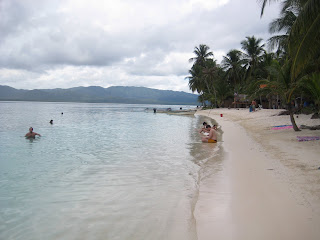
Typical day by the water.
Fortunately, our fellow island guests were a very open bunch. We spent the nights drinking rum and coke, and playing card games under a bright lamp that provided us with illumination until the generator ran out of gas around 10pm each night.
After that, the only two options were to go to sleep, or sit out by the beach looking out at some of the clearest views of the stars that I have ever seen.
The food we were served completely depended on what the Kuna could catch. Luckily, during our stay they served us red snapper the first night, then lobster the second day, followed by crab the last night. They also provided some vegetables and rice as a side. Not bad!
It was very interesting being on such a small island in a remote area, yet hearing conversation in English, Spanish, Kuna, Hebrew, and Dutch. While most travelers spoke English well, we would sometimes have to go through two different translators to tackle the intricacies of a certain situation – such as the rules of a card game or a financial transaction.
During the days we took two trips, one to visit another island where there was a shipwreck that allowed for some great snorkeling, and another trip to a local Kuna island village, to see the living conditions and also hunt for some local Kuna artesanry.
On the first trip, I finally got a chance to chat up our driver, Anel. He was a very pleasant, sincere young man, and I really enjoyed talking to him. He spoke Kuna, as do most of the indians, but he also spoke Spanish perfectly well, so that’s how we conversed.
He told Michael and I about some of the Kuna beliefs about nature and their religion. About how the sun was actually a Kuna warrior, Ibe, that was ordered by mother nature to the sky. Ibe is red in the morning because is always angry, and at night he drifts down below the earth to battle with evils and sicknesses.
Anel also told us about how according to their legends that were passed down orally from generation to generation, the Kuna had come down to the Earth from a golden flying saucer. (No kidding!) And also that one day, they will return to the mainland to live in the jungle.
The Kuna have also noticed the rising sea levels, as any change has a great effect on the land where they live, and that many believe it is the beginning of the Kuna prophecy of their return to the mainland.
He was a very young man, and he liked to joke and had a good sense of humor, but he spoke so freely and with a matter-of-factness about his beliefs.
I commented to him that to me it was impressive that he had such a solid faith in his beliefs at such a young age. He responded back, “It’s not only about believing in your religion, it’s about loving it.” I found that to be a pretty powerful statement, and could think of no response.
At the end of our three days on the island, I ran into Anel in the morning and told him I enjoyed talking with him, and gave him my green Peace Corps hat which I had worn for more than a year and a half, and had always been important to me.
About 10 minutes later he came back to me and told me he would have to return the hat, and he couldn’t offer me anything as well. He explained that according to his beliefs, if you are given an important article of someone else’s, like a piece of clothing, it carries with it a part of their being, or intelligence. So by accepting my gift, he would be taking something from me, and neither could he offer me something of his.
I was disappointed but wasn’t about to tempt the karma of the Kuna indians.
So we reverted to the next best alternative. Or that is, we exchanged email addresses and promised to become Facebook friends!
The trip to San Blas and the Kuna Yalah reserve was incredible. I don’t think Mike or I expect to beat that during our remaining week here in Panama.
Tomorrow we take a bus west for about 7 hours, to a small town called Boquete, near the Costa Rican border and Volcan Baru, to enjoy the freshness of the mountains and some great hiking.
But for now I’ve got to go Facebook my new friend, Anel.
Setting: Robinson Island, the indigenous reservation of Kuna Yalah. Or basically, an archipelago along the Caribbean coast of Panama.
Cast of Characters:
Michael – Age 25. Ex-manager of a Residence Inn in Melbourne, FL, and my traveling companion for these two weeks in Panama.
Elan – Age 28. Works in Real Estate in New York City. Parents are from Isreal. Fluent Hebrew speaker. Extremely funny.
Etsy – Elan’s wife. Works in software development.
Kale – Age 19. Ex-construction worker. Just wrapping up four months of backpacking through Central America. Young guy, but very mature and curious nature. Good sense of humor.
Jaquelyn – Age 18. Traveling with Kale. Also a very mature person with a great attitude and sense of humor.
Anna – Age 25. British, from Manchester. Spent the last 6 months traveling around the work through Southeast Asia, South and Central America. San Blas is her last stop before returning to England.
Tal – Age 27 (approximately). Isreali. Ex-Captain with an Intelligence Service in the Isreali Defense Forces.
Anel – Age 20. Kuna Indian. Spent all his life among the islands. Often our captain when traveling by boat.
“Robinson” – Age 55 (approximately). Kuna Indian. Manager of the island where we were staying. An amateur historian, he studied philosophy and history at the University of Panama.
Some others that deserve mention are a trio of South Africans, an older Swedish gentleman, a Dutch man, two Dutch women, a young Isreali woman, and roughly 40 Kuna indians that inhabit the islands.
On Friday morning, after a long jeep ride to the Caribbean Coast, we boarded a set of boats piloted by the Kuna indians. After a quick trip for gas at one of the islands, we headed further down the coast towards Colombia, to one of over 300 islands that form part of the Kuna reservation.
After arriving to the island, we each talked to Robinson, the island business manager, to negotiate our rate, ($20 a day with three meals a day included), and be assigned to a small cabina.

The huts where we stayed. Ours is on the left.
Roughly 10 minutes later, after accommodating our things, and taking stock after the travel, everyone plodded back out onto the beach to check out our surroundings.
The expanse of approximately 100 meters of beach in front of us, dotted with coconut trees and the occasional hammock was to be our world for the next 72 hours.
Most of our days were spent sitting alongside the beach, or taking a dip in the cool blue water, watching small rain clouds move across the panorama as they passed over the other islands and coastal mountains. (see opening picture)

Typical day by the water.
Fortunately, our fellow island guests were a very open bunch. We spent the nights drinking rum and coke, and playing card games under a bright lamp that provided us with illumination until the generator ran out of gas around 10pm each night.
After that, the only two options were to go to sleep, or sit out by the beach looking out at some of the clearest views of the stars that I have ever seen.
The food we were served completely depended on what the Kuna could catch. Luckily, during our stay they served us red snapper the first night, then lobster the second day, followed by crab the last night. They also provided some vegetables and rice as a side. Not bad!
It was very interesting being on such a small island in a remote area, yet hearing conversation in English, Spanish, Kuna, Hebrew, and Dutch. While most travelers spoke English well, we would sometimes have to go through two different translators to tackle the intricacies of a certain situation – such as the rules of a card game or a financial transaction.
During the days we took two trips, one to visit another island where there was a shipwreck that allowed for some great snorkeling, and another trip to a local Kuna island village, to see the living conditions and also hunt for some local Kuna artesanry.
On the first trip, I finally got a chance to chat up our driver, Anel. He was a very pleasant, sincere young man, and I really enjoyed talking to him. He spoke Kuna, as do most of the indians, but he also spoke Spanish perfectly well, so that’s how we conversed.
He told Michael and I about some of the Kuna beliefs about nature and their religion. About how the sun was actually a Kuna warrior, Ibe, that was ordered by mother nature to the sky. Ibe is red in the morning because is always angry, and at night he drifts down below the earth to battle with evils and sicknesses.
Anel also told us about how according to their legends that were passed down orally from generation to generation, the Kuna had come down to the Earth from a golden flying saucer. (No kidding!) And also that one day, they will return to the mainland to live in the jungle.
The Kuna have also noticed the rising sea levels, as any change has a great effect on the land where they live, and that many believe it is the beginning of the Kuna prophecy of their return to the mainland.
He was a very young man, and he liked to joke and had a good sense of humor, but he spoke so freely and with a matter-of-factness about his beliefs.
I commented to him that to me it was impressive that he had such a solid faith in his beliefs at such a young age. He responded back, “It’s not only about believing in your religion, it’s about loving it.” I found that to be a pretty powerful statement, and could think of no response.
At the end of our three days on the island, I ran into Anel in the morning and told him I enjoyed talking with him, and gave him my green Peace Corps hat which I had worn for more than a year and a half, and had always been important to me.
About 10 minutes later he came back to me and told me he would have to return the hat, and he couldn’t offer me anything as well. He explained that according to his beliefs, if you are given an important article of someone else’s, like a piece of clothing, it carries with it a part of their being, or intelligence. So by accepting my gift, he would be taking something from me, and neither could he offer me something of his.
I was disappointed but wasn’t about to tempt the karma of the Kuna indians.
So we reverted to the next best alternative. Or that is, we exchanged email addresses and promised to become Facebook friends!
The trip to San Blas and the Kuna Yalah reserve was incredible. I don’t think Mike or I expect to beat that during our remaining week here in Panama.
Tomorrow we take a bus west for about 7 hours, to a small town called Boquete, near the Costa Rican border and Volcan Baru, to enjoy the freshness of the mountains and some great hiking.
But for now I’ve got to go Facebook my new friend, Anel.
Thursday, May 20, 2010
Panama City
My friend and travel companion, Michael Schaaf, opened the door to our hostel room at 2am after arriving on a late flight from Miami. I was sound asleep, but had rehearsed the moment in my head beforing going to bed. Following my somewhat pre-scripted plan I looked at his silouette in the doorway, dragged myself out of bed, walked over, gave him a hug and a couple guy-pounds on the back, and said something that was supposed to be encouraging, but I’m pretty sure was unintelligible.
And so our Panama adventures had begun.
The next day, Tuesday morning, we grabbed a cab down to Panama City’s old quarter, called Casco Viejo. On the way we drove past several dozen high-rise apartment complexes and hotels. The air was filled with the sounds of workers yelling from scaffolding, cranes groaning overhead, and the banging of hammers. Panama seems to have not noticed there has been a worldwide economic downturn.
Arriving to Casco Viejo, we hopped out of the cab and began walking around. After about 30 minutes of aimless wandering, on our way to Plaza de Francia, a Panamian guy walked up to us and started jabbering away in Spanish, going into a lengthy explanation about the history of the buildings we were walking past.
He finally stopped talking an hour and a half and a 4-kilometer walk later, after walking through half a dozen churches, the intact home of a pearl merchant from the 18th century, a couple of courtyards, and by remnants of the old city wall. !Ya…es todo!” From the fact that he had stopped outside a local cafeteria, it appeared that it was his lunch time as well.
We were quite pleased with our guide, and since no negotiation had been made beforehand, we were in a pretty strong bargaining position. The guide, whose name was Andres, hinted that in the past he had been tipped up to $20 for his services. I politely informed him that those people most likely had jobs, and more money than we did. We each handed him $3, which he seemed satisfied with, and went on our way.
I suppose another thing worth mentioning is that both Michael and I are unemployed right now. He just resigned from a position with Marriott Residence Inn after 3 ½ years as an assistant manager. So...we got that going for us.
On Wednesday, we went out to the Panama Canal visitors’ center, located alongside one of the locks, Miraflores. A Peace Corps friend, Josh, who had already visited the canal a year before had helped manage my expectations regarding our visit to one of the world’s most impressive engineering feats. “Have you been to the airport and seen planes take off and land?...It’s pretty much as exciting as that,” said Josh.
Despite my friend’s blasé attitude towards the canal, Michael and I thought it was pretty damn cool. Three massive ships passed through the locks as we stood watching from the observation deck.
It was also interesting to learn the history behind not just the canal, but the trans-isthmus crossing. Back in the 16th, 17th, and 18th century the Spanish shipped gold and silver coming from Mexico and South America to the Pacific Coast of the isthmus, and then packed it across with mule trains (heavily armed). Then in the mid-1800s the isthmus experienced another boom as American miners headed to California during the gold rushes.
The miners traveled to the Caribbean coast by steamer, boarded a train that ran from coast to coast, and then hopped on another steamer on the Pacific side that took them to the American West. The isthmus was an extension of the Wild West during those days, with hold-ups and armed gangs being very common.
As all of this was going on, what today is known as Panama, was part of Colombia. Panama did not become a country until 1903, once the U.S. had finally committed itself to building a canal across the isthmus, and Theodore Roosevelt helped engineer a coup which lopped off the section of land that forms the country today. A U.S. friendly Panamian president was installed shortly after. Roosevelt supposedly even bragged about creating the republic out of nothing.
So when I’m in a conversation with a Latin American, and the creation of Panama is used as an example to point out the U.S.’s imperialistic ways, it might be best to cede the point.
I was also unaware that the crossing of Central America through Nicaragua competed with the Panama isthmus crossing, and it was first considered the logical place for a canal to be placed.
All together the canal is 51 miles long and took more than four decades of labor to finish, after the French had their try, and then the Americans completed the work.
In 1914 the canal was opened, and it has been in operation ever since. Actually, the original doors are still used on the locks, so they have been in use for almost 100 years. In 2014 the canal administration is scheduled to complete a new set of locks that will allow some of the bigger boats that are under construction to pass through, thereby keeping the canal competitive.
As for my impressions of Panama City itself, I like the low prices, metropolitan atmosphere, and American food. But at the same time, it puzzles me that they can continue building with such intensity here. It seems they have so much excess capacity in terms of housing and office space, I wonder if they are not fueling their own real estate bubble.
The average Panamian living in the city seems fairly affluent and worldly, with lots of nice cars on the roadways and plenty of jobs in the service sector.
Although on the other hand, we’ve met some Panama Peace Corps volunteers here in the hostel, and they assure us that there are two sides to Panama. The prosperous, bustling city, and the very poor, stagnant small towns and indigenous villages. Here in Panama a significant portion of the Peace Corps volunteers work in indigenous communities, living out of huts and using latrines.
This seems so amazing to me while being surrounded by all these high-rise buildings here in the city. So Panama is definitely fairly affluent, but there are huge imbalances in income distribution.
Some of the volunteers have hinted that it would probably be possible to visit their communities, as most of the small towns have their hand in rural tourism to some degree, but we haven’t been able to define anything at the moment.
Tomorrow (Friday), Michael and I leave the city for the San Blas islands on the Caribbean side. The San Blas islands are governed by an autonomous tribe of indians called the Kuna. The embarcation point by canoe to the islands is only accessible by a 5 hour trip by 4x4 to the coast.
Once reaching the island, visitors have the option of staying on the main island with the majority of the tribe, or being transported out to one of hundreds of tiny islands along the archipelago. Just you, a bunch of palms trees, a latrine, and a hammock on an island the size of a football field.
Or at least that is what I have pieced together from Peace Corps friends and other travelers. But Michael and I will find out for ourselves.
And so our Panama adventures had begun.
The next day, Tuesday morning, we grabbed a cab down to Panama City’s old quarter, called Casco Viejo. On the way we drove past several dozen high-rise apartment complexes and hotels. The air was filled with the sounds of workers yelling from scaffolding, cranes groaning overhead, and the banging of hammers. Panama seems to have not noticed there has been a worldwide economic downturn.
Arriving to Casco Viejo, we hopped out of the cab and began walking around. After about 30 minutes of aimless wandering, on our way to Plaza de Francia, a Panamian guy walked up to us and started jabbering away in Spanish, going into a lengthy explanation about the history of the buildings we were walking past.
He finally stopped talking an hour and a half and a 4-kilometer walk later, after walking through half a dozen churches, the intact home of a pearl merchant from the 18th century, a couple of courtyards, and by remnants of the old city wall. !Ya…es todo!” From the fact that he had stopped outside a local cafeteria, it appeared that it was his lunch time as well.
We were quite pleased with our guide, and since no negotiation had been made beforehand, we were in a pretty strong bargaining position. The guide, whose name was Andres, hinted that in the past he had been tipped up to $20 for his services. I politely informed him that those people most likely had jobs, and more money than we did. We each handed him $3, which he seemed satisfied with, and went on our way.
I suppose another thing worth mentioning is that both Michael and I are unemployed right now. He just resigned from a position with Marriott Residence Inn after 3 ½ years as an assistant manager. So...we got that going for us.
On Wednesday, we went out to the Panama Canal visitors’ center, located alongside one of the locks, Miraflores. A Peace Corps friend, Josh, who had already visited the canal a year before had helped manage my expectations regarding our visit to one of the world’s most impressive engineering feats. “Have you been to the airport and seen planes take off and land?...It’s pretty much as exciting as that,” said Josh.
Despite my friend’s blasé attitude towards the canal, Michael and I thought it was pretty damn cool. Three massive ships passed through the locks as we stood watching from the observation deck.
It was also interesting to learn the history behind not just the canal, but the trans-isthmus crossing. Back in the 16th, 17th, and 18th century the Spanish shipped gold and silver coming from Mexico and South America to the Pacific Coast of the isthmus, and then packed it across with mule trains (heavily armed). Then in the mid-1800s the isthmus experienced another boom as American miners headed to California during the gold rushes.
The miners traveled to the Caribbean coast by steamer, boarded a train that ran from coast to coast, and then hopped on another steamer on the Pacific side that took them to the American West. The isthmus was an extension of the Wild West during those days, with hold-ups and armed gangs being very common.
As all of this was going on, what today is known as Panama, was part of Colombia. Panama did not become a country until 1903, once the U.S. had finally committed itself to building a canal across the isthmus, and Theodore Roosevelt helped engineer a coup which lopped off the section of land that forms the country today. A U.S. friendly Panamian president was installed shortly after. Roosevelt supposedly even bragged about creating the republic out of nothing.
So when I’m in a conversation with a Latin American, and the creation of Panama is used as an example to point out the U.S.’s imperialistic ways, it might be best to cede the point.
I was also unaware that the crossing of Central America through Nicaragua competed with the Panama isthmus crossing, and it was first considered the logical place for a canal to be placed.
All together the canal is 51 miles long and took more than four decades of labor to finish, after the French had their try, and then the Americans completed the work.
In 1914 the canal was opened, and it has been in operation ever since. Actually, the original doors are still used on the locks, so they have been in use for almost 100 years. In 2014 the canal administration is scheduled to complete a new set of locks that will allow some of the bigger boats that are under construction to pass through, thereby keeping the canal competitive.
As for my impressions of Panama City itself, I like the low prices, metropolitan atmosphere, and American food. But at the same time, it puzzles me that they can continue building with such intensity here. It seems they have so much excess capacity in terms of housing and office space, I wonder if they are not fueling their own real estate bubble.
The average Panamian living in the city seems fairly affluent and worldly, with lots of nice cars on the roadways and plenty of jobs in the service sector.
Although on the other hand, we’ve met some Panama Peace Corps volunteers here in the hostel, and they assure us that there are two sides to Panama. The prosperous, bustling city, and the very poor, stagnant small towns and indigenous villages. Here in Panama a significant portion of the Peace Corps volunteers work in indigenous communities, living out of huts and using latrines.
This seems so amazing to me while being surrounded by all these high-rise buildings here in the city. So Panama is definitely fairly affluent, but there are huge imbalances in income distribution.
Some of the volunteers have hinted that it would probably be possible to visit their communities, as most of the small towns have their hand in rural tourism to some degree, but we haven’t been able to define anything at the moment.
Tomorrow (Friday), Michael and I leave the city for the San Blas islands on the Caribbean side. The San Blas islands are governed by an autonomous tribe of indians called the Kuna. The embarcation point by canoe to the islands is only accessible by a 5 hour trip by 4x4 to the coast.
Once reaching the island, visitors have the option of staying on the main island with the majority of the tribe, or being transported out to one of hundreds of tiny islands along the archipelago. Just you, a bunch of palms trees, a latrine, and a hammock on an island the size of a football field.
Or at least that is what I have pieced together from Peace Corps friends and other travelers. But Michael and I will find out for ourselves.
Monday, May 17, 2010
The Trip
Arrived to Panama City, Panama after a 15 hour bus ride from San Jose, Costa Rica. Total distance traveled thus far: 535 miles.
The Trip - What
A 10 week, 5 country journey beginning in San Jose, Costa Rica on May 16th, and ending in La Paz, Bolivia on August 1st. The countries visited will be Panama, Colombia, Ecuador, Peru, and Bolivia, with roughly 2 weeks in each country.
Some of the highlights will be: staying on a private island on an indigenous reserve in Panama, being present for an important presidential election in Colombia on May 30th, a visit to Cuenca, one of the oldest cities in South America in Ecuador, a 5 day trek beginning July 8th through the Andes in Peru to an ancient Incan city, and a bunch of other things that are not even on the itinerary yet, and let's face it, I have no idea what will happen.
Why
Why not? Being at a unique point in my life, having just finished 2 years in Peace Corps, and without any pressing commitments, I'm going to take advantage of the circumstances to see some places I've always wanted to.
The trip will be tough. It will oftentimes be uncomfortable and probably a little unsettling to be in South American cities and countries I have no experience with, but still being in Peace Corps "mode", now seems like an opportune time to do this kind of traveling.
Also, my Spanish language skills are probably at their best right now, so it should be interesting to meet and converse with people from these countries and learn about the culture, politics, and history.
Who
I'll be traveling with friends at times, and also alone in parts of the trip. For example, here in Panama I will be meeting up with a good friend, Michael, who I studied abroad with in Spain. And for Colombia, I will be traveling with a good Peace Corps friend, Derek.
On the other hand, in parts of Colombia, Ecuador, Peru, and Bolivia, I will most likely be going solo. It should be interesting.
Panama City
Having just gotten in to the town and arrived to my hostel, there's nothing really to say at the moment. Lots of tall buildings on the way here from the bus station. Panama City looks to be a pretty modern city.
The plan for the day is to go for a jog, get some dinner with some PC friends that are passing through to Venezuela, and wait for Michael's flight to get in around 1am tonight.
The Trip - What
A 10 week, 5 country journey beginning in San Jose, Costa Rica on May 16th, and ending in La Paz, Bolivia on August 1st. The countries visited will be Panama, Colombia, Ecuador, Peru, and Bolivia, with roughly 2 weeks in each country.
Some of the highlights will be: staying on a private island on an indigenous reserve in Panama, being present for an important presidential election in Colombia on May 30th, a visit to Cuenca, one of the oldest cities in South America in Ecuador, a 5 day trek beginning July 8th through the Andes in Peru to an ancient Incan city, and a bunch of other things that are not even on the itinerary yet, and let's face it, I have no idea what will happen.
Why
Why not? Being at a unique point in my life, having just finished 2 years in Peace Corps, and without any pressing commitments, I'm going to take advantage of the circumstances to see some places I've always wanted to.
The trip will be tough. It will oftentimes be uncomfortable and probably a little unsettling to be in South American cities and countries I have no experience with, but still being in Peace Corps "mode", now seems like an opportune time to do this kind of traveling.
Also, my Spanish language skills are probably at their best right now, so it should be interesting to meet and converse with people from these countries and learn about the culture, politics, and history.
Who
I'll be traveling with friends at times, and also alone in parts of the trip. For example, here in Panama I will be meeting up with a good friend, Michael, who I studied abroad with in Spain. And for Colombia, I will be traveling with a good Peace Corps friend, Derek.
On the other hand, in parts of Colombia, Ecuador, Peru, and Bolivia, I will most likely be going solo. It should be interesting.
Panama City
Having just gotten in to the town and arrived to my hostel, there's nothing really to say at the moment. Lots of tall buildings on the way here from the bus station. Panama City looks to be a pretty modern city.
The plan for the day is to go for a jog, get some dinner with some PC friends that are passing through to Venezuela, and wait for Michael's flight to get in around 1am tonight.
Sunday, May 16, 2010
Leaving Costa Rica
I now know what one of my saddest moments in Costa Rica is. It´s waking up at 4:30am in a dingy hotel room in San Jose to say goodbye to a handful of people who have become your best friends over the previous two years …and then staying in that room as they all file out to head to the airport to catch flights back to the US. Left in the room is just you, a crappy air conditioner cranking out artificial cool air, and a bunch of dirty sheets and towels.
It´s not quite my time to take a flight back to the US. I´ll be doing some other things first, and will get to that in a minute. The focus of this blog is more about saying goodbye…and moving on.
Saying goodbye to Costa Rica – the Peace Corps, people in my community, and other Peace Corps volunteers – has been about a two week process. Thank god it has finally come to a close!
I had no idea saying goodbye would take so much out of me. The most difficult part, easily, was saying goodbye to people I´d worked with in my site, struggled together with on projects, experienced failure and overcome obstacles, and become great friends with.
Last Saturday my counterpart, the community bank, organized a dinner with about 30 people that I worked closely with over the two years in the town. A lot of people, including me, were given an opportunity to say a few words. People were extremely generous in their praise, and there were definitely a few tears shed. I´ve honestly never felt so honored in my life, and wonder whether or not I will ever feel that way again.
When it came to me to say a few words, I started out my apologizing for having failed them during these two years, or that is, for not having found a girlfriend that would cause me to stay in San Cristóbal Norte. Fortunately, that brought out some laughs.
The dinner was a type of Going Away and Welcome party. The new volunteer that is to replace me, Liz, had arrived that same day, and so the bank decided to take advantage of the timing and do both activities on the same day.
Liz is from San Francisco, California, studied business, and will be spending the next two years in San Cristóbal Norte, continuing to support some of the projects I began, and also beginning her own initiatives.
I´m so glad Liz will be there! I had requested a female volunteer be sent to the town to follow me, and fortunately Peace Corps was able to accommodate my request. She seems to be an extremely bright, thoughtful person who I believe will do amazing things during her two years and come to be a wonderful role model for the women of the town – young and old.
So after roughly two weeks of dinners, goodbye parties, cafecitos in friends´ homes, and a million other small chats, I finally left from San José on Wednesday of last week.
One of the most difficult goodbyes was with my 74 year-old host mom, Doña Albertina, who I had lived with and had taken care of me for the last two years. Doña Albertina´s husband passed away about 5 years ago, and although she has a lot of family very close by, I know it was hard for her to see me go.
We had become good friends over the course of the two years, and I know she liked the extra presence in the house I provided, which kept her from feeling so lonely. And I also think she liked the feeling of being needed, as she was responsible for most of my meals. We will continue being friends, and I´m grateful for the time we shared.
After leaving San Cristóbal Norte, I stayed in San José with friends for several days as we completed lots of paperwork in the Peace Corps office to finalize our close of service. We took advantage of the few days to enjoy each others company one last time.
Bros Icing Bros
When my good PC friends get together, the result is usually a mix between a fraternity party, a family reunion, and well…maybe just a fraternity party. A good example of this would be ¨Bros Icing Bros¨, a game that one of my friends, David, stumbled upon on the internet.
The game plays on the aversion most men have for Smirnoff Ice. The rules of the game are basically, any guy presented with a Smirnoff Ice, in any place – whether it is in a bar, restaurant, hotel room, bus, car, or other random setting – must immediately drop to one knee, and slug down the Smirnoff Ice. This is called being ICED!
The only defense one can have against being iced, is to have a Smirnoff Ice on your person at the time of being iced, then the ice is reversed and the other person is then iced. This forces you to choose between the two unhappy scenarios of either having to chug a Smirnoff ice, or having to walk around (being seen) holding a Smirnoff Ice for hours on end.
David insisted that we play, and so once we got the idea (which didn´t take long), and the endless number of possibilities for icing someone, our final days were mostly defined by people getting iced in various random settings.
I hold the dubious honor of being the first person iced. As I stepped out of the bathroom after showering one night, the guys had propped up a Smirnoff outside the bathroom door on top of my friend Marcus´s saxophone case.
Having heard of the game earlier in the day, I understood the implications of finding the Smirnoff Ice, and dropped down the one knee to chug down the drink. However, even if I didn´t know what it meant to find the Smirnoff there, I probably would have figured it out soon enough from the jeering and laughing from the other 5 guys in the room.
So somewhere out there is a picture of me in a towel chugging down the Smirnoff on one knee in our San José hotel room, but unfortunately it’s not available for the blog.
On the flip side, I feel I will get the last laugh, as last night after the guys had gone out for a pre-dinner beer and I was left in the room, I was able to order Smirnoff Ices from the bar and bury them deep into my buddies´ baggage that was to be checked. And so right about now that should be arriving home, unknowingly about to be iced as the start to empty out their bags. Sorry boys, but you had it coming!
Reflections after two years in the Peace Corps
It seems to me that something needs to be said after this whole experience - come kind of conclusions that sum everything up. I still haven´t been able to think of anything too apropo; however, my good friend Josh, who is a good writer, came up with a few things on his blog that I completely agree with, and I wanted to share them with you. Josh´s thoughts:
¨I should say at the outset that there´s no way I could possibly encapsulate my Peace Corps experience in a few paragraphs. So I´m not going to try. I guess that´s what my 20 or so previous blogs, in the aggregate, are more or less for. But with that being said, here are a few thoughts on my experience:
• I made the right decision by joining the Peace Corps. I´ll be honest, I haven´t loved every single moment of my time as a PCV. I´ve been lonely sometimes. I´ve been frustrated sometimes. But then again, I can´t remember any particular period of my life when I loved every single moment. I can say this though: I´ve learned things as a PCV – about myself, about another culture, and perhaps even about the world – that I never would have learned otherwise. I hope and believe that I´ve made a positive difference in the lives of the people in my village. I´m pretty good at Spanish now. I don´t know if any of this will ever serve me in a professional sense in the future (though it probably won´t hurt), but I know that to me the most important thing is that I had a dream, I went for it, and I´ll always be glad that I did. As the sign in the Peace Corps office says: “Peace Corps....it´s about never having to begin your stories with 'I should´ve...'”
• A Peace Corps experience, much like life itself, is what you make it. Like anything else in life, in Peace Corps you get out of your experience what you put in. While there´s no guarantee that if you´re constantly trying to work with your community, staying positive and helping to motivate those around you, and always looking toward sustainability and community ownership of projects that your projects will necessarily be successful and your time as a PCV will necessarily be fruitful. But it´s generally a pretty good formula for success. Likewise, the more time you put into your relationships with members of your community, the more you´ll learn from them, the more you´ll understand them, and probably, the more they´ll learn from and understand you. Life and the relationships that make it meaningful are, of course, two-way streets. I think I´ve always known that, but maybe it didn´t really hit home until about the 30th time I was awkwardly sitting in someone´s house sipping afternoon coffee, making small-talk, and eating some strange food even though I wasn´t even hungry. As much as I love being able to get away from it all and curl up with a good book – and I spent many evenings doing just that after everyone else went to bed – I found that as a PCV my level of happiness was directly correlated (positively) to the number of times that I got out and interacted with other people in my village, regardless of what we ended up doing. In Peace Corps and in life – you just gotta get out there.
• Peace Corps, while not perfect, is an important program. I´ll be the very first person to admit that Peace Corps isn´t perfect (but then, what is?). Sometimes there´s a lot of downtime, little supervision, and adjusting to a new culture and pace of life can make what seems like it should be a simple project take frustratingly long. Maybe you could accomplish more – in a concrete, resume-building sense – by volunteering with an NGO or being in a formal work setting. But I can say with a very high degree of certainty that there is no better way to actually work with and get to know people in developing countries on the grassroots level. There is no better way to really understand a culture and a language than to live with a host family for two years. There is no better way to learn what people really want, what they need, and how you can help them than to spend two years as their neighbor listening to them. In Peace Corps there´s no office to retreat to, no condo to ensconce yourself in. For those two years (and maybe even beyond), you ARE a member of your village, of your community. And I know this too – if more people served as Peace Corps Volunteers, we as Americans would be more culturally understanding, more adaptable to new situations, more willing to listen, and, I believe, the rest of the world would respect us more for it.
• If you really want to, you can probably become a Peace Corps Volunteer (or something similar). While you do have to be medically, legally, and financially cleared to become a Peace Corps Volunteer, the program is really pretty accessible for most college graduates. If you have a chronic health situation, Peace Corps will often work with you. If you have federal student loans, Peace Corps will allow you to defer them (and in the case of Perkins loans, even partially cancel them). There are volunteers right out of college and some that have been retired for years. There are assignments which require prior language or technical skills and others that don´t. There are assignments in cold places and assignments in hot places. You can´t pick a country, but you can express geographic or cultural preferences during your interview. In sum, you have input in the process, and I honestly believe that while Peace Corps is a very challenging experience, it´s something that most people can do if they want to. But even if you for some reason can´t, or don´t want to, become a Peace Corps Volunteer, there are lots of other ways for you to get involved, become part of a community, learn a language, help others, etc. Peace Corps might be one of the most famous service options, but it´s not the only one. Oftentimes it´s just a matter of taking the time to do some internet research or talk to people. Whether you want to live abroad or volunteer after work in your own backyard, I think the most important – and maybe the hardest – step you´ll have to take will be the first one. Like I mentioned before, in Peace Corps as in life – you just gotta get out there.¨The Trip
I´m not going to go into great detail about this topic, as it will be the subject of the next posting, which I should put up within the next day or two.
Basically, I´m not ready to go home yet. Tonight at 11pm I will catch a bus to Panama City, Panama to start off a 10 week, 5 country trip taking me through Panama, Colombia, Ecuador, Peru, and Bolivia.
I will be traveling with friends during parts of the trip, and alone on some legs. This is just something that I want to do, and now being a unique time in my life, I´m going to do it.
I hope to keep the blog well-updated with stories from my travels and the places I visit. Expect postings about twice a week. I hope you can follow along with me on my adventures.
It´s not quite my time to take a flight back to the US. I´ll be doing some other things first, and will get to that in a minute. The focus of this blog is more about saying goodbye…and moving on.
Saying goodbye to Costa Rica – the Peace Corps, people in my community, and other Peace Corps volunteers – has been about a two week process. Thank god it has finally come to a close!
I had no idea saying goodbye would take so much out of me. The most difficult part, easily, was saying goodbye to people I´d worked with in my site, struggled together with on projects, experienced failure and overcome obstacles, and become great friends with.
Last Saturday my counterpart, the community bank, organized a dinner with about 30 people that I worked closely with over the two years in the town. A lot of people, including me, were given an opportunity to say a few words. People were extremely generous in their praise, and there were definitely a few tears shed. I´ve honestly never felt so honored in my life, and wonder whether or not I will ever feel that way again.
When it came to me to say a few words, I started out my apologizing for having failed them during these two years, or that is, for not having found a girlfriend that would cause me to stay in San Cristóbal Norte. Fortunately, that brought out some laughs.
The dinner was a type of Going Away and Welcome party. The new volunteer that is to replace me, Liz, had arrived that same day, and so the bank decided to take advantage of the timing and do both activities on the same day.
Liz is from San Francisco, California, studied business, and will be spending the next two years in San Cristóbal Norte, continuing to support some of the projects I began, and also beginning her own initiatives.
I´m so glad Liz will be there! I had requested a female volunteer be sent to the town to follow me, and fortunately Peace Corps was able to accommodate my request. She seems to be an extremely bright, thoughtful person who I believe will do amazing things during her two years and come to be a wonderful role model for the women of the town – young and old.
So after roughly two weeks of dinners, goodbye parties, cafecitos in friends´ homes, and a million other small chats, I finally left from San José on Wednesday of last week.
One of the most difficult goodbyes was with my 74 year-old host mom, Doña Albertina, who I had lived with and had taken care of me for the last two years. Doña Albertina´s husband passed away about 5 years ago, and although she has a lot of family very close by, I know it was hard for her to see me go.
We had become good friends over the course of the two years, and I know she liked the extra presence in the house I provided, which kept her from feeling so lonely. And I also think she liked the feeling of being needed, as she was responsible for most of my meals. We will continue being friends, and I´m grateful for the time we shared.
After leaving San Cristóbal Norte, I stayed in San José with friends for several days as we completed lots of paperwork in the Peace Corps office to finalize our close of service. We took advantage of the few days to enjoy each others company one last time.
Bros Icing Bros
When my good PC friends get together, the result is usually a mix between a fraternity party, a family reunion, and well…maybe just a fraternity party. A good example of this would be ¨Bros Icing Bros¨, a game that one of my friends, David, stumbled upon on the internet.
The game plays on the aversion most men have for Smirnoff Ice. The rules of the game are basically, any guy presented with a Smirnoff Ice, in any place – whether it is in a bar, restaurant, hotel room, bus, car, or other random setting – must immediately drop to one knee, and slug down the Smirnoff Ice. This is called being ICED!
The only defense one can have against being iced, is to have a Smirnoff Ice on your person at the time of being iced, then the ice is reversed and the other person is then iced. This forces you to choose between the two unhappy scenarios of either having to chug a Smirnoff ice, or having to walk around (being seen) holding a Smirnoff Ice for hours on end.
David insisted that we play, and so once we got the idea (which didn´t take long), and the endless number of possibilities for icing someone, our final days were mostly defined by people getting iced in various random settings.
I hold the dubious honor of being the first person iced. As I stepped out of the bathroom after showering one night, the guys had propped up a Smirnoff outside the bathroom door on top of my friend Marcus´s saxophone case.
Having heard of the game earlier in the day, I understood the implications of finding the Smirnoff Ice, and dropped down the one knee to chug down the drink. However, even if I didn´t know what it meant to find the Smirnoff there, I probably would have figured it out soon enough from the jeering and laughing from the other 5 guys in the room.
So somewhere out there is a picture of me in a towel chugging down the Smirnoff on one knee in our San José hotel room, but unfortunately it’s not available for the blog.
On the flip side, I feel I will get the last laugh, as last night after the guys had gone out for a pre-dinner beer and I was left in the room, I was able to order Smirnoff Ices from the bar and bury them deep into my buddies´ baggage that was to be checked. And so right about now that should be arriving home, unknowingly about to be iced as the start to empty out their bags. Sorry boys, but you had it coming!
Reflections after two years in the Peace Corps
It seems to me that something needs to be said after this whole experience - come kind of conclusions that sum everything up. I still haven´t been able to think of anything too apropo; however, my good friend Josh, who is a good writer, came up with a few things on his blog that I completely agree with, and I wanted to share them with you. Josh´s thoughts:
¨I should say at the outset that there´s no way I could possibly encapsulate my Peace Corps experience in a few paragraphs. So I´m not going to try. I guess that´s what my 20 or so previous blogs, in the aggregate, are more or less for. But with that being said, here are a few thoughts on my experience:
• I made the right decision by joining the Peace Corps. I´ll be honest, I haven´t loved every single moment of my time as a PCV. I´ve been lonely sometimes. I´ve been frustrated sometimes. But then again, I can´t remember any particular period of my life when I loved every single moment. I can say this though: I´ve learned things as a PCV – about myself, about another culture, and perhaps even about the world – that I never would have learned otherwise. I hope and believe that I´ve made a positive difference in the lives of the people in my village. I´m pretty good at Spanish now. I don´t know if any of this will ever serve me in a professional sense in the future (though it probably won´t hurt), but I know that to me the most important thing is that I had a dream, I went for it, and I´ll always be glad that I did. As the sign in the Peace Corps office says: “Peace Corps....it´s about never having to begin your stories with 'I should´ve...'”
• A Peace Corps experience, much like life itself, is what you make it. Like anything else in life, in Peace Corps you get out of your experience what you put in. While there´s no guarantee that if you´re constantly trying to work with your community, staying positive and helping to motivate those around you, and always looking toward sustainability and community ownership of projects that your projects will necessarily be successful and your time as a PCV will necessarily be fruitful. But it´s generally a pretty good formula for success. Likewise, the more time you put into your relationships with members of your community, the more you´ll learn from them, the more you´ll understand them, and probably, the more they´ll learn from and understand you. Life and the relationships that make it meaningful are, of course, two-way streets. I think I´ve always known that, but maybe it didn´t really hit home until about the 30th time I was awkwardly sitting in someone´s house sipping afternoon coffee, making small-talk, and eating some strange food even though I wasn´t even hungry. As much as I love being able to get away from it all and curl up with a good book – and I spent many evenings doing just that after everyone else went to bed – I found that as a PCV my level of happiness was directly correlated (positively) to the number of times that I got out and interacted with other people in my village, regardless of what we ended up doing. In Peace Corps and in life – you just gotta get out there.
• Peace Corps, while not perfect, is an important program. I´ll be the very first person to admit that Peace Corps isn´t perfect (but then, what is?). Sometimes there´s a lot of downtime, little supervision, and adjusting to a new culture and pace of life can make what seems like it should be a simple project take frustratingly long. Maybe you could accomplish more – in a concrete, resume-building sense – by volunteering with an NGO or being in a formal work setting. But I can say with a very high degree of certainty that there is no better way to actually work with and get to know people in developing countries on the grassroots level. There is no better way to really understand a culture and a language than to live with a host family for two years. There is no better way to learn what people really want, what they need, and how you can help them than to spend two years as their neighbor listening to them. In Peace Corps there´s no office to retreat to, no condo to ensconce yourself in. For those two years (and maybe even beyond), you ARE a member of your village, of your community. And I know this too – if more people served as Peace Corps Volunteers, we as Americans would be more culturally understanding, more adaptable to new situations, more willing to listen, and, I believe, the rest of the world would respect us more for it.
• If you really want to, you can probably become a Peace Corps Volunteer (or something similar). While you do have to be medically, legally, and financially cleared to become a Peace Corps Volunteer, the program is really pretty accessible for most college graduates. If you have a chronic health situation, Peace Corps will often work with you. If you have federal student loans, Peace Corps will allow you to defer them (and in the case of Perkins loans, even partially cancel them). There are volunteers right out of college and some that have been retired for years. There are assignments which require prior language or technical skills and others that don´t. There are assignments in cold places and assignments in hot places. You can´t pick a country, but you can express geographic or cultural preferences during your interview. In sum, you have input in the process, and I honestly believe that while Peace Corps is a very challenging experience, it´s something that most people can do if they want to. But even if you for some reason can´t, or don´t want to, become a Peace Corps Volunteer, there are lots of other ways for you to get involved, become part of a community, learn a language, help others, etc. Peace Corps might be one of the most famous service options, but it´s not the only one. Oftentimes it´s just a matter of taking the time to do some internet research or talk to people. Whether you want to live abroad or volunteer after work in your own backyard, I think the most important – and maybe the hardest – step you´ll have to take will be the first one. Like I mentioned before, in Peace Corps as in life – you just gotta get out there.¨The Trip
I´m not going to go into great detail about this topic, as it will be the subject of the next posting, which I should put up within the next day or two.
Basically, I´m not ready to go home yet. Tonight at 11pm I will catch a bus to Panama City, Panama to start off a 10 week, 5 country trip taking me through Panama, Colombia, Ecuador, Peru, and Bolivia.
I will be traveling with friends during parts of the trip, and alone on some legs. This is just something that I want to do, and now being a unique time in my life, I´m going to do it.
I hope to keep the blog well-updated with stories from my travels and the places I visit. Expect postings about twice a week. I hope you can follow along with me on my adventures.
Subscribe to:
Posts (Atom)
